





 21% THCa







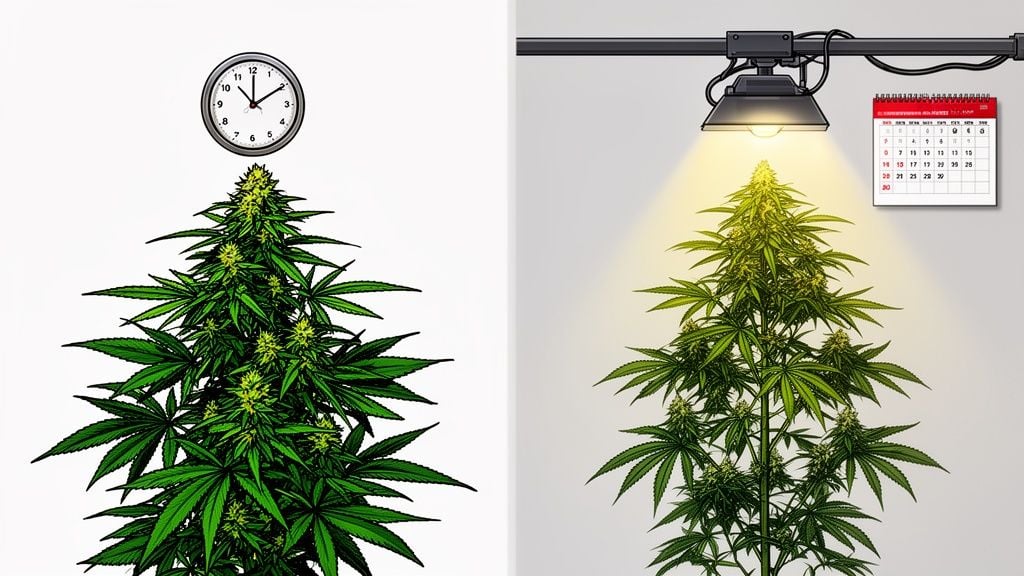
When you’re trying to decide between autoflower vs feminized seeds, the choice really comes down to speed versus control. Think of it this way: autoflowers are the sprinters—they race to the finish line on their own internal clock, no matter what you do with the lights. This makes them fantastic for beginners or anyone needing a quick turnaround.
On the other hand, feminized photoperiods are the marathon runners. You’re the coach, and you get to train them, control their growth, and decide exactly when they start to flower. The trade-off for that control is a longer grow time, but the reward can be massive plants with truly impressive yields.
Your Quick Guide to Choosing the Right Cannabis Seeds
So, you’re ready to start your own grow, but the sheer variety of cannabis seeds can feel overwhelming. Let’s cut through the noise. Choosing between autoflower and feminized seeds isn’t about finding the “best” seed—it’s about finding the best seed for you. Your growing space, your schedule, and what you want out of your harvest will point you in the right direction.
We’ll get into the nitty-gritty of genetics and grow cycles soon, but let’s start with a high-level overview. This side-by-side comparison should give you a quick feel for what makes each type unique.
Autoflower vs Feminized Seeds at a Glance
Before we dive deep, this table breaks down the core differences. It’s a great starting point for making a quick, informed decision based on what’s most important for your setup.
| Characteristic | Autoflower Seeds | Feminized (Photoperiod) Seeds |
|---|---|---|
| Flowering Trigger | Age-based; switches automatically | Light-cycle based; requires a 12/12 flip |
| Seed to Harvest | Extremely fast (8-10 weeks) | Much longer (3-6+ months) |
| Plant Size | Compact and discreet | Can be trained to grow very large |
| Yield Potential | Moderate | High to very high |
| Grower Control | Low (the plant runs on its own schedule) | High (you dictate the vegetative time) |
| Training Methods | Low-Stress Training (LST) is best | Handles both LST & High-Stress Training (HST) |
| Cloning | Not practical or recommended | Straightforward and effective |
| Ideal Grower | Beginners, small-space growers, fast harvests | Experienced growers, yield maximizers |
As you can see, the autoflower vs feminized debate is really about what you prioritize. Are you looking for a fast and simple grow, or do you want the hands-on control needed to cultivate a monster plant? Keep these key traits in mind as we explore what really makes each of these seed types tick.
Understanding the Genetics Behind Your Grow
To really get what separates autoflower and feminized seeds, you have to look under the hood at their DNA. Don’t worry, this isn’t a heavy science lecture. Think of it as understanding why a sports car is built for speed while a pickup truck is built for hauling—it’s all about their fundamental design.
The core difference boils down to one simple question: what tells the plant it’s time to make flowers? For traditional feminized seeds, the answer is light.
The Power of Light: Feminized Photoperiod Seeds
Feminized seeds are photoperiodic, a fancy term meaning they react to changes in the light cycle, just like plants do in nature. When the long days of summer start getting shorter, that’s the signal for them to stop growing leaves and start producing buds. As a home grower, you have to mimic this natural trigger.
You’re completely in the driver’s seat. By keeping your lights on for 18+ hours a day, you can hold a feminized plant in its vegetative growth stage for as long as you want, letting it get bigger and stronger. Once you’re ready for flowers, you just flip your light timer to a 12/12 schedule—12 hours of light, 12 hours of uninterrupted darkness.
This level of control is precisely why photoperiods have been the gold standard for so long. Growers want guaranteed female plants packed with cannabinoid-rich flowers, and the control offered by photoperiods delivers that reliably.
Key Takeaway: With feminized seeds, you are the boss. The plant waits for your signal—the change in light—to start flowering. This gives you total command over its size and how long it stays in the vegetative stage.
The Automatic Timer Inside Autoflower Seeds
Now, let’s talk about autoflowers. These are the rebels of the cannabis world, playing by their own set of rules. They couldn’t care less about your light schedule. Their flowering trigger is simply age.
This unique trait comes from a tough, wild cannabis subspecies called Cannabis ruderalis. Hailing from harsh climates with short summers like Siberia, ruderalis had to evolve for survival. It learned to flower as fast as possible, no matter how much daylight there was, in a race against the first frost. You can find more on this fascinating plant by exploring the origins of Cannabis ruderalis.
Breeders brilliantly crossed this hardy ruderalis with well-known indica and sativa strains. The result? Autoflowers that keep the potent traits of their famous parents but inherit that all-important automatic flowering gene.
This means an autoflower will switch from vegetative growth to flowering all on its own, usually after just 3-4 weeks from sprouting.
- No Light Flip Needed: You can keep your lights on an 18/6 or even a 20/4 schedule from seed to harvest.
- A Predetermined Lifespan: The plant’s entire life is on a fixed, accelerated schedule that you can’t really extend.
- Compact by Nature: This rapid switch to flowering is the main reason autoflowers typically stay much smaller than their photoperiod cousins.
So, when we’re comparing autoflower vs. feminized seeds, it’s not just about speed. It’s a fundamental genetic difference that dictates how you’ll manage your entire grow, from the light timer all the way to the final plant size.
Comparing the Full Seed to Harvest Timeline
As a grower, your time is one of your most precious resources. The decision between autoflower and feminized seeds will fundamentally shape your entire cultivation calendar. One is a dead sprint to the finish line, while the other is a marathon that you get to pace yourself. Understanding these timelines is crucial for planning a harvest that actually works for your schedule and goals.
Think of autoflowers as the express train to harvest. They’re built for pure, unadulterated speed.
Feminized seeds, on the other hand, operate on a more traditional schedule. You’re the conductor, and you decide exactly when the plant moves from vegetative growth into flowering.
The Autoflower Sprint to the Finish Line
When people say autoflowers are fast, they aren’t kidding. Many varieties can take you from a freshly sprouted seed to a fully mature plant ready for harvest in as little as 8 to 10 weeks. This incredible speed is hardwired into their DNA; they run on a fixed biological clock that you can’t really influence.
This rapid lifecycle is a game-changer for a lot of growers. If you’re in a climate with a short growing season, an autoflower ensures you can pull down a harvest long before the first frost even thinks about showing up. It also means you can plan for multiple, staggered harvests in a single season. You could pop one batch in May, another in July, and keep your jars full all summer long.
Key Insight: The autoflower timeline is non-negotiable. Its internal clock dictates a rapid, set-in-stone lifecycle, making it perfect for growers who need a predictable and swift harvest without managing light cycles.
Here’s a rough sketch of how those few weeks fly by:
- Weeks 1-3 (Seedling & Early Veg): The plant pops and starts its vegetative growth. Even from day one, that internal timer is already ticking down.
- Weeks 4-5 (Flowering Begins): Without any change from you, the plant automatically shifts into its flowering stage. You’ll start to see the first pistils and tiny bud sites forming.
- Weeks 6-10 (Bud Development & Harvest): This is where all the action happens as the buds swell and mature. By week 10, a lot of strains are ready for the chop.
For those who need an even faster turnaround, breeders have developed hyper-specialized strains. If speed is your absolute number one priority, you can learn more about these genetics in our guide to fast-flowering cannabis seeds.
The Feminized Marathon: A Patient Approach
Feminized photoperiod seeds demand a totally different mindset—one built on patience and control. This isn’t a fixed sprint; it’s a marathon where you get to decide how long the first leg of the race lasts.
The total timeline for a feminized plant can stretch from 3 to 6 months, sometimes even longer. It’s all broken down into two very distinct phases that are entirely in your hands.
Controlled Vegetative Growth
First up is the vegetative stage, where the plant’s only job is to get bigger and stronger. You keep it in this phase by giving it 18 or more hours of light each day. This is where your control really shines. You can let it veg for just a few weeks for a smaller plant, or for several months if you’re aiming to grow a massive outdoor tree. This is your chance to train, top, and shape the plant to build a solid foundation for a huge yield.
The Flowering Stage Commitment
Once you’re satisfied with the plant’s size and structure, you trigger the flowering stage. You do this by switching the light schedule to a strict 12 hours on, 12 hours off. This “flip” mimics the shortening days of late summer and tells the plant it’s time to make buds. From that point, the flowering period itself will last another 8 to 12 weeks, depending on the strain’s genetics.
So, when it comes down to the full timeline, the choice is clear: do you want a quick, automated process, or a longer, more hands-on journey that gives you ultimate control over the plant’s final size and potential harvest?
Yields, Potency, and Training: Where the Real Differences Emerge
Let’s cut to the chase and talk about what really matters to most growers: the final haul. How much flower can you expect, how strong will it be, and how can you shape your plants to maximize both? This is where the practical differences between autoflowers and feminized photoperiods really come into focus.
When you’re talking about sheer harvest potential, feminized photoperiod seeds almost always take the crown. The reason is simple: you are in complete control of the vegetative cycle. You can let a photoperiod plant veg for months, growing it into a monstrous bush before you even think about flipping the lights to a 12/12 schedule. More time to grow means a bigger plant, more branches, and ultimately, a much heavier yield.
However, I need to clear up a common misconception right away. Many growers, especially those new to the scene, think that autoflowers produce weaker, less potent buds. That might have been the case a decade ago, but modern genetics have completely changed the game.
Potency Isn’t the Issue Anymore
Today’s top-shelf autoflowers can easily stand shoulder-to-shoulder with photoperiods when it comes to THC. Breeders have worked magic over the years, stabilizing genetics to create plants that are both incredibly fast and incredibly potent. It’s not at all uncommon to find autoflower strains pushing 25% THC or more, with terpene profiles that rival their photoperiod cousins.
The real distinction isn’t about the maximum possible potency. It’s more about the development window. A feminized plant’s longer flowering period gives it more time to fully mature its cannabinoid and terpene profiles, which can sometimes result in a more complex and robust final product. But the old myth that autoflowers are “weak” is officially dead.
The most significant practical difference between these two types of seeds reveals itself when we start talking about plant training. Your actions here can make or break your final yield, and the rules of engagement are totally different for each.
High-Stress vs. Low-Stress Training
Think of training as a way to sculpt your plant for maximum efficiency. Most cannabis plants naturally want to grow like a Christmas tree, with one dominant central cola. Training breaks this habit, creating a flat, even canopy where every bud site gets drenched in light. This is how you go from an “okay” harvest to a spectacular one.
With feminized plants, you have the gift of time. This means you can get aggressive with high-stress training (HST) techniques, which involve strategically damaging the plant to encourage more productive growth patterns.
- Topping: This is the classic technique of snipping off the plant’s main stalk. The plant responds by splitting its energy, growing two new main colas where there was once only one.
- Super Cropping: Here, you carefully pinch and bend a branch until the inner fibers soften, allowing you to lay it down at a 90-degree angle. This opens up the canopy and redirects growth hormones to lower branches.
- Screen of Green (ScrOG): This is an advanced method that uses a horizontal screen above the plant. As branches grow, you weave them through the screen, creating a perfectly level sea of buds. To really master this, check out our in-depth guide on how to ScrOG marijuana plants for a step-by-step walkthrough.
These HST methods are perfect for feminized seeds because you can give the plant plenty of time in the vegetative stage to recover, heal, and come back stronger than ever.
For Autoflowers, Low-Stress is the Only Way to Go
Now, if you try topping or super cropping an autoflower, you’re probably going to be disappointed. Remember, autoflowers operate on a fixed biological clock; they are in a race against time from the moment they sprout. They simply don’t have the weeks needed to recover from the shock of high-stress training. Any stunting during their brief vegetative phase will directly and permanently slash your final yield.
This is why for autoflowers, the philosophy is low-stress training (LST). This is all about gently persuading the plant to grow how you want without causing damage. The most popular method is to use soft garden ties to bend the main stem and side branches downward and outward, securing them to the side of the pot.
This simple, gentle technique achieves two crucial goals:
- It breaks the plant’s apical dominance (its tendency to focus on the main cola), sending more growth energy to the lower branches, turning them into main colas themselves.
- It opens up the entire plant canopy to better light and airflow, preventing those fluffy, underdeveloped “popcorn” buds from forming in the shaded middle.
By sticking to LST, you can dramatically boost your autoflower’s yield without causing the kind of stress that would bring its rapid growth to a screeching halt.
Which Type of Seed Should You Grow?
Alright, we’ve covered the genetics, timelines, and training methods. Now it’s time to get to the heart of it: which of these seeds is actually right for you? This isn’t about crowning a winner in the autoflower vs. feminized debate. It’s about matching the right genetics to your specific goals, space, and experience level.
Think of this as a practical gut check. Let’s walk through a few common grower scenarios to see where each seed type really shows its strengths.
The First-Time Grower
If you’re just dipping your toes into growing, the best strategy is to keep things simple. The goal for your first run is a successful harvest, not necessarily a monster yield. You need a plant that’s forgiving and won’t throw a fit if you make a few rookie mistakes.
For this reason, autoflowers are the clear winner for most beginners. Their biggest advantage is that they flower on their own, taking the most complex variable—light cycle management—out of the equation. No stressing about light leaks or perfectly timing the flip to 12/12. Just give them good light, water, and food, and they’ll do their thing.
The Small-Space Cultivator
Working with a small grow tent in a closet, a stealthy cabinet, or a sunny corner on your balcony? When every inch counts, you need a plant that stays compact and won’t get out of control.
This is another situation where autoflowers are the ideal choice. Thanks to their Cannabis ruderalis heritage, they are genetically programmed to stay short and bushy. Most autoflowers won’t grow much taller than three feet, which is perfect for micro-grows where vertical space is a luxury. While you can train a feminized photoperiod to stay small, its natural instinct is to stretch, requiring a lot more hands-on work.
Key Insight: For growers who prioritize discretion and a small footprint, autoflowers are a perfect match. Their predictable, compact size makes planning a low-key grow incredibly straightforward.
The Yield Maximizer
If you’ve got a few harvests under your belt and your main goal is to get the heaviest harvest possible, the choice becomes much clearer. To get huge yields, you need a plant you can shape and sculpt into a beast before it even starts to flower.
For the grower chasing massive yields, feminized photoperiod seeds are unbeatable. Having full control over the vegetative stage is your superpower. You can let a plant veg for weeks—or even months—using high-stress training (HST) like topping and super cropping to build a massive, multi-branched canopy. A longer veg time creates a bigger, stronger root system and frame, which directly translates to a much heavier final harvest.
This decision tree helps visualize how your main goal should dictate your training strategy, which ultimately points to one seed type over the other.
As the flowchart shows, if you’re all about maximizing yield, you’ll need the advanced training techniques that only a feminized photoperiod plant can truly handle.
The Medical Grower Needing Consistency
For many medical users, the moment you find a strain that delivers the perfect relief is a game-changer. Once you’ve found that “keeper,” the mission becomes replicating it flawlessly to ensure a consistent and reliable supply of medicine.
In this situation, feminized seeds are the only practical option. Their critical advantage is the ability to be cloned. You can keep a single “mother plant” in a perpetual vegetative state with 18+ hours of light, taking genetically identical cuttings from it forever. This guarantees that every plant you grow will have the exact same cannabinoid profile, effects, and growth patterns. Because autoflowers run on a non-stop internal clock, they can’t be cloned, making feminized seeds essential for long-term consistency.
Finding Your Perfect Strain at Growers Choice Seeds
Alright, you’ve got the lowdown on autoflower vs. feminized seeds. Now for the best part—choosing your strains and getting ready to grow. Picking the right genetics from the get-go is the foundation of a successful harvest, and we’re here to help you find the perfect lab-tested seeds for your setup.
We’re so confident in our genetics that we back every seed with a rock-solid 90% germination guarantee. This gives you peace of mind knowing your investment is safe, whether you’re popping a speedy auto or a massive photoperiod. It’s our way of making sure you get a strong start, every time.
Top Picks for Every Grower
To help narrow it down, here are a few of our most popular strains that line up with the goals we’ve been talking about. Think of this as your starting point.
-
For the Beginner Wanting Speed and Simplicity: You really can’t go wrong with Gorilla Glue Auto. It’s a legend for a reason—this strain is tough as nails, forgiving of common mistakes, and finishes lightning-fast without any light schedule headaches. It’s the perfect, low-stress way to grow your first batch of killer flower.
-
For the Grower Chasing Massive Yields: If your main goal is filling up those jars, our cup-winning White Widow Feminized is the one. With a little training and a decent veg time, this plant can turn into an absolute monster, pushing out a huge harvest of frosty, powerful buds.
Our Promise to You: Starting with strong genetics is everything. We hand-inspect and test every batch to ensure you’re getting premium, reliable seeds capable of producing top-shelf results.
Selecting Seeds Based On Your Setup
It’s not just about choosing between autoflower or feminized. You can really dial in your selection to fit your exact needs. Our strain finder lets you filter by key traits, so you can find the ideal match for your grow space and personal tastes.
For example, you can fine-tune your search by:
- THC Potency: From mellow, easygoing strains to heavy-hitters pushing 25% THC and higher.
- Plant Height: Find compact plants perfect for a small tent or towering sativas for an outdoor garden with room to stretch.
- Difficulty: Filter for beginner-friendly options or challenge yourself with some expert-level exotic genetics.
In the end, the choice between autoflower vs. feminized seeds really boils down to what you prioritize. Whether you need a quick, discreet grow or you want to cultivate a massive, high-yielding beast, Growers Choice Seeds has the trusted genetics to make it happen.
No matter which path you take, starting with top-tier genetics is the most important step. Growers Choice Seeds has a massive selection of lab-tested autoflower and feminized seeds, and we stand behind them with a 90% germination guarantee. Find your next favorite strain and begin your growing adventure with total confidence.
FAQs
Can I Clone an Autoflower Plant?
You technically can, but it’s a terrible idea in practice. The simple truth is, it just doesn’t work the way you want it to.
Think of an autoflower’s life cycle as being on a non-stop timer from the moment it sprouts. A clone is genetically identical to the mother plant, which means it shares the exact same internal clock. So, if you take a cutting from a three-week-old autoflower, that cutting is also, for all intents and purposes, three weeks old. It will start flowering right on schedule with its mom, leaving it no time to grow roots or bulk up. You’ll just end up with a sad little twig with a couple of tiny buds.
For growers who are serious about keeping a specific genetic line going, feminized (photoperiod) plants are the only way to go. You can keep a mother plant in a vegetative state for as long as you want, taking countless healthy clones from her whenever you’re ready to start a new batch.
Are Feminized Seeds Harder to Grow?
“Harder” isn’t the right word; they just require more hands-on management. With a feminized plant, you’re the one calling the shots. You have complete control over when the plant flips from growing leaves and stems to producing flowers. That power comes with responsibility—you have to be the one to physically change your light timer to a 12/12 cycle to trigger flowering.
Autoflowers, on the other hand, take care of that major life change all by themselves. This makes them incredibly forgiving for beginners or anyone who just wants a more set-it-and-forget-it grow. When it comes to the daily tasks like watering and feeding, the workload is pretty much the same for both.
Which Seed Type Is Better for Outdoor Growing?
This is a classic question, and the answer really comes down to your local climate and what you’re trying to accomplish. Both can thrive outdoors, but they fit very different growing strategies.
Autoflowers are a lifesaver for growers in regions with short or unpredictable summers. Their lightning-fast timeline, often just 8-10 weeks from seed to harvest, means you can pull down your crop well before the first frost even thinks about showing up. It also opens up the possibility of staggering your planting for multiple harvests in a single season.
Feminized seeds are for those blessed with long, sun-drenched growing seasons who want to go big. An outdoor feminized plant can grow into a monstrous, tree-sized beast with a truly massive yield, but it needs every bit of that long season to do it.
So, if speed and multiple smaller harvests are your goals, autoflowers are your best bet. If you have the climate for it and want one gigantic harvest, feminized seeds are the clear winner.