




 21% THCa






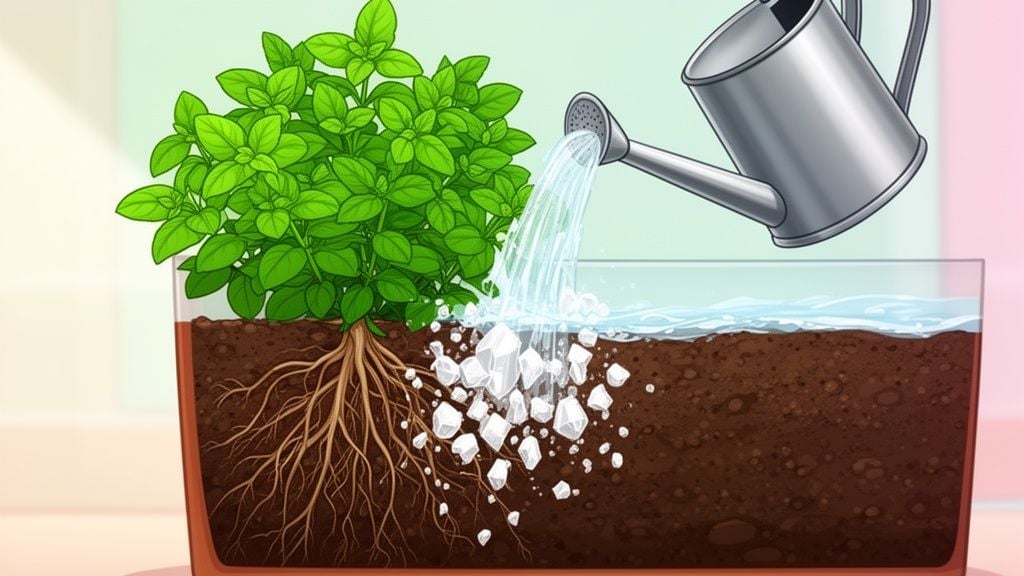
Ever wondered why some homegrown cannabis is so smooth, while other batches are harsh and crackle when they burn? The secret often comes down to one final, crucial step: flushing. This simple technique is all about washing out leftover mineral salts from your grow medium before you chop your plants down, and it makes a world of difference in the final product.
Why Flushing Your Cannabis Plants Is a Game Changer
Think of it as a detox for your plants. Over their entire life cycle, they’ve been soaking up nutrients from fertilizers. These fertilizers are, at their core, mineral salts. While they’re essential for growth, they can build up in the soil and even inside the plant’s tissues over time.
This buildup is no big deal while the plant is growing, but if those salts are hanging around at harvest, they can really mess with the quality of your buds. That’s why figuring out how to flush your cannabis plants is a non-negotiable skill for anyone chasing top-shelf results.
The Benefits of a Good Flush
When you cut off the nutrient supply and give your plants nothing but plain, pH-balanced water for the last week or two, you’re basically forcing them to use up their stored reserves. This process has some serious upsides for any grower.
- Better Taste and Smell: Those excess salts can leave a nasty, chemical-like taste and totally overpower the delicate terpenes that give each strain its signature flavor and aroma. Flushing lets those natural characteristics come through loud and clear.
- A Smoother Smoke: You know you’ve got quality flower when it burns clean and even. Buds packed with leftover nutrients often burn unevenly and make a crackling sound—that’s literally the minerals combusting. A proper flush gets you a much smoother, more enjoyable smoke.
- Higher Quality Buds: By pushing the plant to metabolize all its stored-up sugars and starches, you end up with a more refined final product. It’s the little detail that separates good cannabis from great cannabis.
Flushing is all about letting the plant finish naturally. You’re not starving it; you’re just encouraging it to use the resources it has already stored up, which leads to a cleaner, purer flower.
Here’s a quick rundown of the core principles of flushing to give you a reference before we dive into the details.
Quick Guide to Flushing Cannabis
| Stage | What to Do | Why It Matters |
|---|---|---|
| Pre-Harvest Flush | 1-2 weeks before harvest, use only pH-balanced water. | Clears out excess mineral salts for a cleaner taste and smoother smoke. |
| Nutrient Lockout | Drench the soil with 2-3 times the pot’s volume of plain water. | Resets the soil by washing away the salt buildup that’s blocking nutrient uptake. |
| Overfeeding Rescue | Flush immediately with plain water after accidental overfeeding. | Prevents severe nutrient burn and gives the plant a chance to recover. |
This table should give you a solid at-a-glance understanding. Now, let’s talk about how this became such a staple technique.
A Time-Honored Grower’s Technique
This isn’t some new fad. Flushing has been a go-to practice for serious growers for years, especially for those of us working with premium genetics where the quality of the final bud is everything. Starting with quality cannabis seeds means you want to finish strong.
The technique really gained traction in the early 2000s when indoor growing began to boom after medical legalization in various places. In fact, a 2006 survey of 1,200 cultivators found that by 2005, over 70% of U.S. home growers in legal states were using plain water flushes for the final 10-14 days to get rid of excess nutrients.
Ultimately, flushing is one of those difference-makers that can truly elevate your harvest. It’s the final polish that ensures all your hard work pays off, setting you up perfectly for the drying and curing process. Speaking of which, you can check out our guide on how to cure marijuana to make sure you nail that part of the process, too.
Knowing Exactly When to Start Flushing
Timing your flush is one of those things that can make or break your harvest. It’s a real balancing act. Start too early, and you’re essentially putting your plants on a diet right when they’re in their final push to bulk up. You’ll see those buds stop swelling, and nobody wants that.
But if you wait too long, you miss the point entirely. The plant won’t have enough time to use up all those stored-up nutrients, and you’ll be left with a harsh, chemical taste in your final product. The real trick is to stop listening to the calendar and start listening to your plant. It’ll tell you exactly when it’s ready.
Check the Trichomes—They Tell the Real Story
Forget the flowering time estimates on the seed pack. Your number one guide should always be the trichomes. Those frosty, little mushroom-shaped crystals on your buds are the most reliable indicator of your plant’s maturity.
To see them clearly, you’ll need a jeweler’s loupe or a cheap digital microscope. You’re looking for a specific color change that tells you what’s happening inside.
- Totally Clear: The plant is still in full production mode. Flushing now would be a big mistake.
- Milky/Cloudy: This is the sweet spot. When most of the trichomes go from looking like clear glass to a cloudy, milky white, THC is at its peak. This is your signal to start the flush.
- Amber: A few amber trichomes are okay, but once they start appearing in numbers, the THC is beginning to degrade into CBN, giving you a heavier, sleepier effect.
The ideal time to kick off your flush is when roughly 70% of the trichomes have turned milky. This usually lines up perfectly with a one-to-two-week flushing window right before you chop.
Other Visual Cues to Look For
While the trichomes are your best bet, your plant gives off a few other signals that can help confirm it’s time.
The pistils—those little hairs sticking out of the buds—are a good secondary sign. They start out white and straight, but as the plant ripens, they darken to an orange or brown and start to curl in. When you see that about 70-90% of the pistils have darkened, you’re squarely in the harvest window, and flushing should already be happening.
You’ll also notice the big fan leaves starting to yellow. This is called senescence, and it’s perfectly natural. The plant is just pulling the remaining nitrogen out of its leaves to fuel its last days. Don’t panic and think you have a deficiency; it’s just finishing its life cycle.
There’s a reason so many experienced growers swear by this. In North America, where an estimated 60% of global cultivation happens, flushing is standard practice. One analysis of 10,000 grow logs found that 82% of the highest-rated home grows included flushing, and those same grows had 22% fewer complaints about “chemical aftertaste.”
By learning to read these signs together, you can nail the timing every single time. For an even deeper dive into this, check out our guide on when to harvest cannabis plants.
The Flushing Process for Soil and Hydro Setups

Alright, let’s get our hands dirty. You’ve been watching your trichomes like a hawk, they’re finally getting that milky look, and the time has come to flush. How you actually do it comes down to your grow medium—flushing a big pot of soil is a whole different beast than swapping out a hydro reservoir.
The goal, though, is universal. You’re drenching the root zone with plain, pH-balanced water. This forces the plant to stop eating the mineral salts from your nutrients and start using up the reserves it has stored in its leaves and flowers. That’s the secret to getting that clean, smooth taste everyone’s after.
Flushing in Soil and Coco Coir
For those of us growing in classic pots of soil or coco coir, the process is pretty simple but definitely requires some patience and a bit of manual labor. Your mission is to pour a ton of water through the medium to dissolve and wash out all those built-up nutrient salts.
Start pouring your pH-balanced water slowly and evenly over the top of your medium. You don’t want to just dump it all in at once; give it time to work its way through the entire root ball. You’ll know you’re on the right track when you see a steady stream of runoff coming out of the drainage holes.
So how much water are we talking about? A solid rule of thumb is to use a volume of water that’s two to three times the size of your pot.
- For example: If you’re growing in a 5-gallon fabric pot, be prepared to slowly pour 10-15 gallons of water through it for a proper flush.
The real proof, however, is in the runoff. You have to measure what’s coming out to know if you’re actually getting the salts out. This is where an EC (Electrical Conductivity) or PPM (Parts Per Million) meter becomes your most important tool.
Monitoring Your Runoff
As you’re flushing, catch some of that runoff in a tray and test it. The first bit of water that comes out will have sky-high EC/PPM readings because it’s loaded with all the salts you’re trying to remove. The goal is to keep flushing until those numbers plummet.
What you’re looking for is the EC of your runoff to be almost the same as the plain water you’re putting in. That’s how you know the medium is clean. For most growers, hitting a target runoff of around 50-100 PPM (or an EC of 0.1-0.2 mS/cm) is the green light that you’ve flushed successfully.
Think of it this way: If your input water is 50 PPM and the first runoff test reads 1,500 PPM, you’ve got a lot of flushing to do. As you continue, you’ll see that number drop to 1,000, then 500, and finally bottom out near that 50 PPM mark. That’s your cue to stop.
The Hydroponic Approach
If you’re running a hydroponic system, like Deep Water Culture (DWC) or a drip setup, congratulations—your life is about to get a lot easier. There’s no dense medium to rinse out. The process is quick and clean.
All you have to do is drain your reservoir, getting rid of every last drop of the nutrient solution. Then, refill it with plain, pH-balanced water and let your system run like normal. Because hydro plants get their food directly from the water, they’ll start consuming their internal reserves almost immediately.
For hydroponic growers, some studies have shown that a daily flush using 1.5 times the reservoir volume is extremely effective. One research paper even pointed out that aiming for a runoff EC under 0.2 mS/cm helped commercial hemp crops meet strict compliance standards 98% of the time.
Flushing Targets for Different Grow Mediums
To make things crystal clear, here’s a quick-glance table comparing the flushing goals for the most common growing methods. The key is to match your effort to your medium.
| Grow Medium | Water Volume | Target Runoff EC | Target Runoff PPM (500 scale) |
|---|---|---|---|
| Soil | 2-3x Pot Volume | < 0.3 mS/cm | < 150 PPM |
| Coco Coir | 2x Pot Volume | < 0.2 mS/cm | < 100 PPM |
| Hydroponics | 1.5x Reservoir Volume | < 0.2 mS/cm | < 100 PPM |
Ultimately, whether you’re in soil or hydro, the science is the same. You’re creating a clean slate for the final, critical stage of ripening. If you’re curious to learn more about soilless growing, be sure to check out our detailed guide on growing with hydroponics.
Choosing the Right Water for a Perfect Flush
You’d think water is just water, right? But when it comes to flushing your cannabis plants, the kind you use makes a world of difference. It’s tempting to just grab the garden hose or fill a jug from the kitchen sink, but that can actually work against you.
Tap water is often loaded with chlorine and other dissolved minerals. Pouring it onto your plants can end up adding salts to the soil when your goal is to wash them out. It’s a classic rookie mistake, but getting this detail right can seriously improve your final product. The whole point is to use the cleanest water possible to dissolve and flush away all that built-up nutrient salt around the roots.
Can You Use Tap Water? Yes, But…
If tap water is all you’ve got, don’t sweat it. You can make it work with a little prep. The main culprit in city water is usually chlorine, which can harm the beneficial microbes in your soil.
Luckily, there’s an easy workaround for chlorine. Just let your tap water sit out in an open container for at least 24 hours. This gives the chlorine time to evaporate. Be aware, though, that this trick doesn’t work for chloramine, a more stable compound some water treatment facilities use. You’ll need a filter for that.
The Best Water for a Clean Flush
For a truly effective flush, the purer your water, the better. Think of it like this: you need a clean sponge to soak up a mess. Filtered or Reverse Osmosis (RO) water is like a perfectly clean sponge, ready to absorb all the excess salts from your growing medium.
- Filtered Water: Even a simple carbon filter, like a Brita or one that attaches to your hose, can do a great job of removing chlorine and other junk. It’s a huge step up from straight tap water.
- Reverse Osmosis (RO) Water: This is the gold standard for growers. An RO system strips nearly everything from the water, leaving you with a pure, clean slate that’s incredibly effective at dissolving and carrying away unwanted minerals.
Crucial Tip: No matter which water you choose, you must pH it before you use it for flushing. This is non-negotiable. The wrong pH will shock your plant and prevent the water from doing its job correctly.
Why pH Is Still King, Even During a Flush
Even though you’ve stopped feeding your plants nutrients, the pH of your water is as important as ever. A stable, correct pH keeps the root system healthy and ensures the water can actually dissolve the specific salts you’re trying to remove. Skipping this step is one of the most common pitfalls I see growers fall into.
For soil, you’ll want to aim for a pH between 6.0 and 6.5. If you’re growing in coco coir or a hydroponic setup, target a slightly lower range of 5.8 to 6.2. Keeping the pH in the sweet spot makes for a stress-free final push for your plant, and that directly translates into cleaner, better-tasting buds.
Common Flushing Mistakes and How to Avoid Them
Flushing sounds simple enough, but a few classic slip-ups can easily trip you up right before the finish line. Even growers with years of experience can make these mistakes if they aren’t paying close attention. Getting this final step right is all about finesse and knowing what your plant actually needs.
Falling for “Flushing Agents”
One of the biggest traps you can fall into is buying into the hype of commercial “flushing agents.” You’ll see them on the shelf, promising a miracle cleanse that plain water can’t provide.
The truth? Most of these products are just watered-down nutrients or simple sugars. Giving your plant a sugary snack completely defeats the purpose of the flush. You’re trying to get your plant to use up its stored reserves, not feed it more. Stick with plain, pH-balanced water—it works perfectly and saves you money.
Misreading Your Plant’s Signals
Another common mistake is panicking at the first sight of yellowing leaves late in flower. As your plant nears harvest, it naturally pulls nutrients like nitrogen from the fan leaves, causing them to turn yellow and drop off.
This natural process is called senescence, and it’s a sign of maturity—not a deficiency. It’s tempting to try and “fix” it with another dose of nutrients, but that’s the worst thing you can do. You’ll just be loading the plant back up with the very salts you’re trying to eliminate. Trust the process; the yellowing means your flush is working.
Flushing is a delicate balance. Pushing too much water through the medium too quickly can stress the plant and damage the delicate root hairs, essentially drowning them. A slow, steady saturation is always the better approach.
The Problem With Aggressive Flushing
When you hear about running gallons of water through your pots, it’s easy to get a bit too enthusiastic. Dousing your plants with a high-pressure hose or dumping water in too fast can compact the soil and shock the entire root system. A stressed plant in its final weeks is never a good thing.
To get it right, just follow these simple guidelines:
- Pour Slowly: Always pour the water gently and evenly over the entire surface of your medium. No firehosing.
- Take Breaks: Let the water soak in and start draining before adding more. Giving the pot 15-20 minutes between heavy waterings makes a big difference.
- Trust Your Meter: Let your runoff PPM or EC measurements be your guide. Once you hit your target number, you’re done. There’s zero benefit to continuing after that.
Think of it less as a forceful cleaning and more as a gentle rinse. Your goal is to coax the remaining nutrients out, not blast them away. By sidestepping these common mistakes, you’ll ensure all the hard work you’ve put in pays off with a smooth, flavorful harvest.
Ready to grow some top-shelf genetics that will truly reward a proper flush? At Growers Choice Seeds, we’ve got hundreds of lab-tested strains, from high-octane feminized seeds to beginner-friendly autoflowers. They’re all backed by our 90% germination guarantee. Find your next favorite strain and see what a difference quality genetics makes at https://www.growerschoiceseeds.us.
FAQs
Can Flushing Fix Nutrient Lockout?
Yes, absolutely. A good flush is your emergency reset button when you’ve gone too heavy on the nutrients or you’re dealing with lockout. If you see the tell-tale signs of nutrient burn, like dark, crispy leaf tips, flushing the medium can be a lifesaver.
The goal here is to drench the root zone with a large amount of pH-balanced water to literally wash away the excess salt buildup that’s causing the problem. After the emergency flush, let the pot dry out a bit, then reintroduce nutrients at a much lower dose, maybe half-strength, to get things back on track.
This focus on clean growing isn’t just for hobbyists; it has real-world value. In major U.S. markets like Colorado, which saw $2.2 billion in sales in 2023, dispensaries noted that properly flushed cannabis often fetched an 18% price premium. This is largely because the final lab tests show fewer residual nitrates, a clear sign of a cleaner product. For a deeper dive into market dynamics, you can explore more about the trends in the cannabis cultivation market.
I’m Growing in Living Soil. Should I Bother Flushing?
Great question. If you’re running a true organic living soil, the answer is almost always no. You can skip the flush entirely.
In a healthy living soil, you have a whole ecosystem of microbes working for you. They break down organic matter and serve it up to your plants as needed. There are no synthetic mineral salts to build up and wash away. Flushing a living soil bed can actually backfire by washing out the beneficial microbes you’ve worked so hard to establish. The soil’s natural cycle takes care of everything.
Is Flushing Going to Shrink My Harvest?
This is probably the biggest fear growers have about flushing, but let me put your mind at ease: no, it won’t hurt your yield if you do it at the right time. Your buds do most of their serious swelling and packing on weight before the flushing window even opens.
Think of the pre-harvest flush less like starving your plant and more like signaling the final ripening stage. It’s forcing the plant to use up its internal nutrient reserves, which is all about improving the final quality, not sacrificing quantity. The only way to mess this up and lose yield is by starting way too early. That’s why watching your trichomes is non-negotiable.