





 21% THCa







When you’re growing autoflowers, picking the right soil isn’t just a suggestion—it’s pretty much the whole foundation for a great harvest. The perfect mix is light, airy, and not packed with nutrients. This kind of setup lets the roots take off like a rocket without getting overwhelmed right out of the gate.
Since autoflowers are on a short, fixed timeline, they need a home that gives them excellent drainage and airflow from day one. There’s just no time to recover from a bad start.
Why Your Soil Choice Makes Or Breaks An Autoflower Grow
It helps to think of an autoflower as a sprinter, not a marathon runner. The second that cannabis seed cracks open, a clock starts ticking down to harvest day, and you can’t hit pause. This plant has a very short window to live its entire life, and it absolutely cannot afford any setbacks. This is exactly why your soil choice is probably the most important decision you’ll make.
Unlike photoperiod plants, which you can keep in their vegetative stage to recover from stress, an autoflower is going to switch to flowering no matter how healthy or big it is. If the soil is too dense, packed down, or soggy, its sensitive roots will have a tough time expanding and breathing. That early struggle can pretty much seal its fate.
The Problem With Heavy Or “Hot” Soil
Dense, clay-like soils are an autoflower’s worst nightmare. They hold way too much water, basically suffocating the roots and setting up the perfect conditions for root rot. This brings all growth to a screeching halt, which is a death sentence for a plant on such a tight schedule. You can learn more about different types of cannabis seeds and what they need in our guide to autoflower cannabis seeds.
At the same time, a soil that’s too “hot”—meaning it’s loaded with aggressive, strong nutrients—is just as bad. This can easily burn the delicate roots of a young seedling. This early stress can permanently stunt the plant, leading to a disappointingly small harvest.
For an autoflower, a slow start means a small finish. There’s no recovery period. The goal is to give it a fluffy, low-resistance home where roots can just explode, building the foundation for a healthy plant and dense, frosty buds.
Give Them What They Need
At the end of the day, the best soil for autoflowers is one that’s a lot like where they came from. Autoflowers get their genetics from Cannabis ruderalis, a tough little plant that learned to thrive in poor, rocky soils.
A well-draining, organic-rich soil can boost your yield potential by as much as 30% compared to a compacted, dense medium. A simple trick is to add 25-50% perlite to your mix. This stops the soil from getting waterlogged and makes sure the roots get all the oxygen they need. You can find more insights about how soil impacts autoflower yields on royalqueenseeds.com.
The Three Core Ingredients for Perfect Autoflower Soil
We’ve covered why the right soil is such a game-changer for autoflowers. Now, let’s get our hands dirty and break down what actually goes into a top-tier mix. You don’t need a degree in botany to figure this out; it really boils down to three key components. Think of it like a recipe for a great cake—get the main ingredients right, and you’re pretty much guaranteed a good result.
Every successful autoflower soil is built on these three pillars: a structural base, something for aeration, and a gentle source of organic matter. Nailing the ratio between these three is the secret to giving your cannabis plants the perfect start they need to really take off.
The Foundation: Your Base
The base is the main ingredient, making up the bulk of your mix. Its job is to provide structure and hold onto water, creating a stable home for your plant’s roots. You’ve got a couple of excellent choices here, and they each have their own vibe.
- Coco Coir: Made from shredded coconut husks, coco is brilliant at holding water while staying light and fluffy. It’s also naturally sterile and pH-neutral, which means you’re starting with a clean slate.
- Peat Moss: This is the old-school classic. Peat is a powerhouse for holding moisture, but it can be a bit acidic. You’ll often need to add a bit of lime to get the pH in the right zone.
Both work great as a foundation. The key thing is, neither contains many nutrients on its own, which is exactly what a sensitive autoflower seedling needs at the very beginning.
The Aeration: Your Soil’s Lungs
Next, we need to think about aeration. This is what stops your soil from becoming a dense, waterlogged brick. Good aeration creates tiny air pockets throughout the medium, giving roots the oxygen they need to breathe and grow freely. Without it, roots struggle and can even suffocate.
For this, you’ll want to add one of these:
- Perlite: Those little white, styrofoam-like balls you see in most potting mixes? That’s perlite. It’s a type of volcanic glass that’s incredibly lightweight and does an amazing job of creating air pockets and improving drainage.
- Vermiculite: This mineral is a bit more sponge-like than perlite. It helps with aeration but also holds onto a little extra moisture, which can be a nice bonus.
Adding a healthy scoop of one of these is like giving your plant’s root system a set of lungs. It’s the best defense against overwatering and is absolutely essential for explosive root growth.
The Nutrition: Your Food Source
Finally, we mix in the organic matter. This is where your plant will get its first meals. But remember our sprinter analogy? We’re not preparing a heavy, five-course dinner here. We need a light, slow-release snack that won’t overwhelm the young plant.
The biggest mistake new growers make is using soil that is too “hot” or nutrient-rich. This causes nutrient burn, scorching the delicate new roots and stunting the plant for good before it ever has a chance.
Your safest and most effective options for gentle nutrition are:
- Worm Castings: This stuff is gold. It’s loaded with beneficial microbes and provides a perfectly gentle, slow release of nutrients that won’t ever burn your seedlings. It’s pretty much foolproof.
- High-Quality Compost: Well-finished compost offers a balanced diet of micronutrients and also improves the soil’s overall texture. Just make sure it’s fully broken down and not too strong.
By getting this three-part recipe right, you create the ideal environment for your autoflower: a stable foundation, plenty of oxygen for the roots, and just enough food to get things going. This balanced approach is the key to unlocking the full genetic potential hidden inside that little cannabis seed.
DIY Soil Recipes Versus Store-Bought Mixes
When it comes to getting the perfect soil for your autoflowers, you’re at a fork in the road. Do you roll up your sleeves and play mad scientist, mixing your own custom blend? Or do you grab a convenient, ready-to-go bag from the store?
Honestly, there’s no single “right” answer here. The best choice really comes down to your goals, your budget, and how much time you want to put in. Let’s break down both paths.

Mixing Your Own Soil: The Ultimate Control
Going the DIY route gives you complete and total command over what goes into your plant’s home. You get to hand-pick every ingredient, making sure there are no mystery components or overly aggressive fertilizers that could harm your sensitive autos.
While buying the bulk ingredients might seem a bit steep at first, it’s almost always cheaper in the long run, especially if you plan on doing more than one grow. One bag of perlite or worm castings can last you for several grow cycles, making it incredibly economical over time.
This flowchart gives you a great visual guide to piecing together a stellar mix based on the core principles of drainage and airflow.
As you can see, it all starts with a solid base, then you layer in amendments for aeration and a gentle, steady source of nutrients.
A Simple, No-Fail DIY Autoflower Soil Recipe
Ready to get your hands dirty? Here’s a tried-and-true recipe that’s practically bulletproof. It creates that light, fluffy, and fast-draining medium that autoflowers absolutely love.
- 50% Base: Your foundation. Use a quality, low-nutrient medium like coco coir or peat moss. This will make up half of your total mix.
- 25% Aeration: Time to add perlite. This is the magic ingredient that creates tiny air pockets, letting roots breathe and stretch out. Don’t skip this.
- 25% Organic Matter: Finish with some high-quality worm castings. Think of this as a slow-release buffet for your plant, providing gentle nutrition without the risk of burning your seedlings.
This simple 50/25/25 formula creates the perfect environment for an autoflower’s rapid growth. With their short life cycle, there’s simply no time to waste recovering from heavy, waterlogged soil. You can dig deeper into why this specific soil blend works so well for autoflowers on dinafem.org.
Using Store-Bought Mixes The Smart Way
Now, let’s be real—sometimes convenience wins. Grabbing a bag of something popular like Fox Farm Ocean Forest is a tempting shortcut, and for good reason. These mixes work.
But there’s a big catch for autoflowers: they are often way too “hot” (nutrient-rich) for seedlings.
These premium soils are packed with nutrients meant for larger, more established plants. Throw a tiny, brand-new seedling into that environment, and you risk severe nutrient burn. This can easily stunt its growth for good, and with an autoflower, there’s no time to recover.
The trick is to simply “cut” the hot soil. Mix it 50/50 with a neutral, nutrient-free medium like plain coco coir or a basic seedling starter mix. This dilutes the nutrient load, making it perfectly safe for a young plant.
This approach gives you the best of both worlds: the ease of a pre-made bag without the rookie mistake of burning your plants.
To help you decide, here’s a quick comparison of the two approaches.
DIY Super Soil Recipe vs. Store-Bought Mixes
| Factor | DIY Soil Mix | Store-Bought Soil (e.g., Fox Farm) |
|---|---|---|
| Control | 100% control over every ingredient and ratio. | Limited control; you get what’s in the bag. |
| Cost | Higher initial investment, but much cheaper per grow in the long run. | Lower upfront cost for a single bag, but more expensive over time. |
| Convenience | Requires time and effort to source, measure, and mix components. | Extremely convenient. Just open the bag and you’re ready to plant. |
| Suitability | Can be perfectly tailored to be gentle enough for seedlings from day one. | Often too “hot” for seedlings and requires amending (diluting). |
| Learning Curve | A great way to learn about soil science and plant needs. | Plug-and-play, but you learn less about the “why” behind the soil. |
Ultimately, whether you mix your own soil or buy it off the shelf, the key is understanding what an autoflower needs. Both paths can lead to a fantastic harvest as long as you respect the plant’s need for a light, airy, and gentle start to life.
Choosing The Right Pot For A Stress-Free Start
You’ve mixed the perfect soil, but you’re only halfway there. The container you choose for that soil is just as critical as what’s in it. Think of it this way: even the best cannabis seeds can’t reach their potential if the roots have nowhere to go. For autoflowers, getting this right from the start is non-negotiable because of one simple rule: they hate being transplanted.
An autoflower’s internal clock starts ticking the moment it sprouts. It just doesn’t have the luxury of time to recover from the stress and root shock of being moved from a starter pot to a bigger one. A stressed autoflower is a stunted autoflower, plain and simple. That’s why you absolutely must plant your germinated seed directly into its final container.
Making this one decision sidesteps a whole host of problems later on and gives your plant a clear, uninterrupted path to a heavy harvest.
Fabric Pots vs. Plastic Pots
When it’s time to pick a pot, you’ll generally find yourself choosing between classic plastic containers and modern fabric pots. Plastic pots are cheap and you can use them over and over, but they have a serious flaw—they encourage plants to become root-bound. Once a root hits that solid plastic wall, it has nowhere to go but sideways, eventually circling the pot and creating a tangled, inefficient mess that can choke the plant.
Fabric pots, on the other hand, are a total game-changer, especially for autoflowers.
Fabric pots allow roots to breathe and naturally “air-prune.” When a root tip reaches the fabric wall and is exposed to air, it stops growing outward and instead sends out new feeder roots deeper within the soil. This creates a much healthier, more fibrous root ball.
This natural pruning process builds a dense and highly efficient root network. The plant can absorb water and nutrients far more effectively, which translates directly into faster growth and bigger yields. If you’re serious about getting the best results, fabric is the way to go. For more tips on creating the ideal environment, check out our guide on growing cannabis indoors.
Finding The Sweet Spot For Pot Size
So, how big should this final pot be? For most growers cultivating autoflowers indoors, the sweet spot is a 3- to 5-gallon (11-19 liter) container.
- Smaller than 3 gallons: The plant is likely to run out of room for its roots, which will put a hard cap on its final size and yield.
- Larger than 5 gallons: You’re probably just wasting good soil. Most autoflowers won’t grow big enough to take full advantage of the extra real estate.
A pot in that 3- to 5-gallon range gives the roots plenty of space to develop without the soil staying soggy for too long. It’s the perfect balance for a healthy, happy, and productive plant.
Watering And Feeding: Nailing The Daily Routine
Alright, your autoflower is in its final pot and you’ve got the perfect soil. Now the real fun begins—the day-to-day care. This is where a lot of first-time growers get a little anxious, but don’t sweat it. Watering and feeding are all about listening to your plant.
If there’s one mistake that plagues new growers, it’s overwatering. It’s easy to do! We want to shower our plants with love, but too much water literally suffocates the roots and opens the door for root rot. Forget the old “stick your finger in the soil” trick; there’s a much better way.
Learn To Water By Weight
The most reliable method to tell if your plant needs a drink is simply to pick up the pot. Seriously, that’s it. After you initially water your plant in its new soil, get a good feel for how heavy the pot is. A day or two later, lift it again. The difference will be striking.
This is the “pot lift” method, and it’s your new best friend. Wait until the pot feels significantly lighter before you even think about watering again. This simple practice creates the perfect wet-dry cycle that roots absolutely crave.
When you do water, pour it slowly until you see about 10-20% of the water drain out the bottom. This little bit of runoff is a good thing—it flushes out excess salts and ensures the entire root zone gets evenly soaked. For a deeper dive, check out our guide on when to water your weed plants.
A Light Hand With Nutrients
If you used one of the rich soil mixes we talked about, you get to sit back and relax for a bit. Your plant has plenty of food to power through its first 2-4 weeks. Feeding a young seedling is one of the fastest ways to burn it out before it even gets going.
Once you see that initial explosive growth start to level off, it might be time to introduce a little extra food in the form of liquid nutrients. Just remember the golden rule: start low and go slow.
- Start at a quarter strength: Whatever the nutrient bottle says, ignore it for now. Begin with just 25% of the recommended dose.
- Watch for the reaction: After a feeding, give the plant a couple of days. If she looks happy and green, you can consider a tiny increase next time.
- Look for burnt tips: If the very tips of your leaves turn yellow or brown, that’s the classic sign of “nute burn.” Back off immediately and give the plant only plain, pH-balanced water for the next cycle to flush things out.
Don’t Sleep On pH
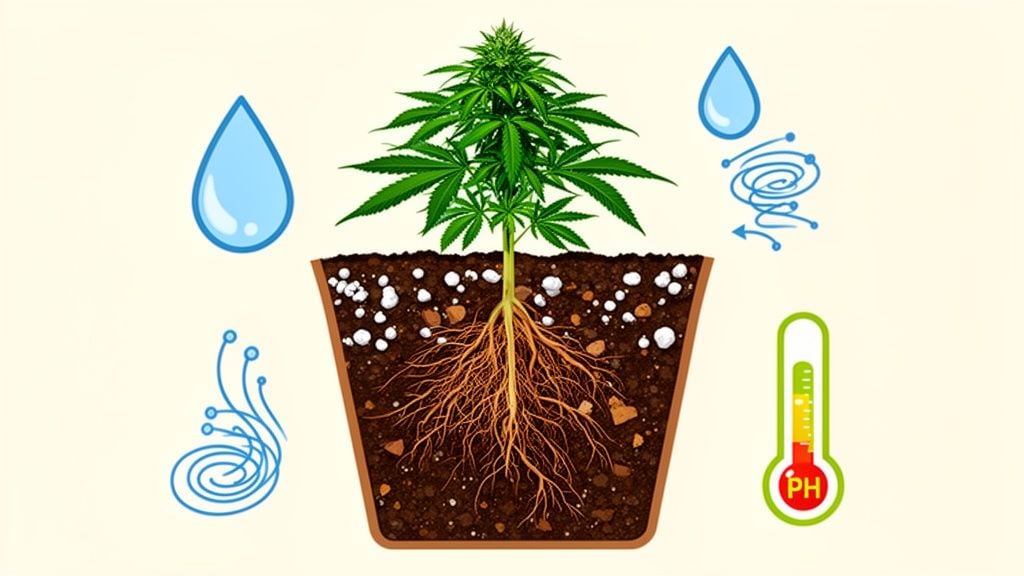
Last but not least, let’s talk about pH. It sounds technical, but it’s actually pretty simple. Think of pH as the gatekeeper for nutrients. If the pH is off, the gate is locked, and your plant can’t “eat” the food in the soil, even if it’s swimming in it.
For autoflowers, you want to keep your soil pH in the sweet spot between 6.0 and 7.0. This is the range where all the essential nutrients are unlocked and available to the plant, with the absolute peak right around 6.5. This is a huge reason why good organic soils, used by 80% of U.S. home cultivators, are so fantastic—they naturally help keep the pH stable. You can read more about the ideal pH levels for autoflowers on 2fast4buds.com.
Ready to put this knowledge to the test with some top-shelf genetics? At Growers Choice Seeds, we specialize in lab-tested, high-germination cannabis seeds that are perfect for your soil setup. Check out our amazing selection of autoflower strains and start your next grow with confidence.
Shop for premium autoflower cannabis seeds at Growers Choice Seeds
FAQs
What Are The Signs My Soil Is Wrong For My Autoflower?
Your plant will definitely tell you if it’s unhappy with its living situation. The trick is learning to speak its language. Since autoflowers are on such a short, fast-paced timeline, catching problems early is absolutely critical—they don’t have time to bounce back from a rough start.
Keep an eye out for these common red flags:
Stunted Growth: This is the big one. If your seedling looks like it’s stuck in neutral after the first week or two, your soil is the number one suspect. It’s likely either too dense for the roots to explore or way too “hot” (heavy on nutrients).
Burnt Leaf Tips: See those tiny, crispy brown or yellow tips on your leaves? That’s a classic symptom of nutrient burn. It’s a very common sight when growers use a rich, pre-fertilized potting mix without lightening it up first.
A Droopy, Waterlogged Look: If the leaves are hanging down heavy and sad—even when the top inch of soil feels dry—that’s a huge warning sign. It usually means the soil is holding onto too much water deep down, effectively drowning the roots and starving them of oxygen.
Starting with the right soil from day one—something light, airy, and not overloaded with nutrients—is your single best defense against these problems. It creates a stress-free environment where your plant can put all its energy where it counts: growing big, beautiful buds.
Is Living Soil A Good Choice For Autoflowers?
Living soil is an absolutely brilliant option for autoflowers, but I’d file it under “advanced techniques.” A good living soil is more than just dirt; it’s a complete, living ecosystem in a pot. It’s teeming with beneficial bacteria, fungi, and other microscopic critters that work together to break down organic matter and spoon-feed your plant exactly what it needs.
The real magic of a well-run living soil is its simplicity during the grow. You often just add water. The soil’s “food web” handles the complex nutrient delivery, which can lead to some truly mind-blowing flavors and aromas in your final harvest.
The catch is the setup. Getting that ecosystem balanced and thriving takes time, a bit of know-how, and a larger upfront investment. For your first few runs, I always recommend sticking with a simpler DIY mix or a quality bagged soil. Once you’ve got a couple of successful harvests under your belt, making the jump to living soil is a fantastic way to level up your game.
Can I Reuse My Soil For The Next Autoflower Grow?
Technically, yes, you can. But it’s not as simple as pulling out the old plant and popping in a new cannabis seed. Think of it this way: your last plant was a hungry dinner guest. It ate up a lot of the nutrients and left the soil a bit compacted and tired.
If you want to reuse it properly, you have to “re-amend” it. This involves breaking up the old root ball, fluffing the soil, and mixing in fresh goodies like compost, worm castings, and a healthy dose of perlite to bring back that light, airy structure. After mixing it all up, it’s best to let it “cook” for a couple of weeks to let the microbial life get re-established.
Honestly, though? If you’re new to this, just start with fresh soil. It’s the safest and easiest path to success. A fresh bag takes all the guesswork out of the equation, guaranteeing a clean, perfectly balanced home for your next plant.